
A Year After USAID: Reclaiming Control of Data Systems
Just months after the 2025 U.S. aid freeze was announced, Development Gateway published a blog post warning that the USAID cuts would result in a data crisis, with some countries losing access to their digital health data. Nearly a year on, how have those systems – and the countries relying on them – fared?
The aid freeze and funding cuts revealed deep vulnerabilities in existing systems, often long-known problems that were now hard to ignore: fragmentation, lack of country ownership and policy alignment, and a heavy reliance on external funding. Since January 2025, more than two-thirds of national statistical offices (NSOs) report experiencing funding reductions, with 73 percent reporting negative impacts on data used to monitor the Sustainable Development Goals (SDGs).
These system-wide disruptions were perhaps most visible in the disruption of flagship data initiatives such as the Demographic and Health Surveys (DHS) Program. Funded primarily by USAID, the DHS Program was one of the 90 percent of programs whose contracts were canceled in 2025. While philanthropic donors provided temporary funding to complete ongoing survey rounds and keep the program running for up to three more years, its longer-term sustainability remains uncertain. The interruptions to the DHS Program risk creating multi-year gaps in nationally representative health data. As a result, the gaps in health data are likely to impair development planning and resource allocation, weaken monitoring of progress toward the SDGs, and complicate compliance with international reporting obligations.
While global surveys and data operations already point to widespread strains, country-level experiences reveal more about how these disruptions are unfolding in practice. For example, our partners in Ethiopia shared how the suspension of livestock information systems and zoonotic disease monitoring initiatives reinforced the vulnerability of externally funded and owned surveillance architecture, while Kenya and Zambia temporarily lost access to critical health data systems.
In addition to these disruptions, gender data systems were also significantly affected. According to the Global Aid Freeze Tracker, after governance, health and gender were the thematic areas most affected by the aid freeze. And while gender data have never been adequately financed, the decline in support for the DHS program – a rich source of internationally comparable gender statistics – undermined data collection in key areas, including gender-based violence, with the potential of disrupting research, policymaking, and urgent interventions.
These sector-level impacts reflect broader systemic challenges. Open Data Watch, in a discussion paper for the 57th Session of the UN Statistical Commission, posits that NSOs, particularly in low- and middle-income countries, are facing a “perfect storm” of converging pressures: a decline in funding, fragile political will and public trust, and long-standing capacity issues, coupled with AI disruption and a rising demand for “inclusive data” (disaggregated by gender, age, and disability).
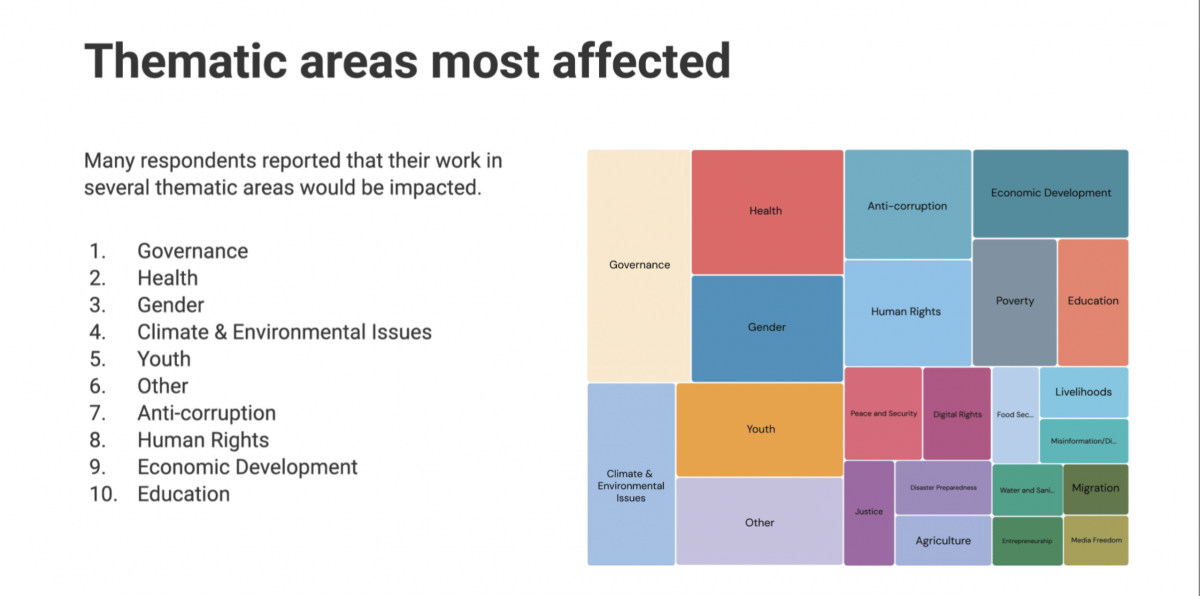
Image courtesy of: Global Aid Freeze Tracker
How countries are responding
In response, countries are placing renewed emphasis on data sovereignty, regional cooperation, and local resource mobilization to build more resilient data systems that are not wholly reliant on external funding. Across Africa, this shift is reflected in efforts to prioritize locally governed and hosted data and surveillance infrastructure, reducing reliance on externally funded systems, even as new funding models are testing the limits of that sovereignty.
At the same time, countries are increasingly investing in greater ownership, sustainable systems, and nationally integrated digital ecosystems to strengthen long-term control over how data are collected, managed, and shared. This is evident in investments in Digital Public Infrastructure (DPI) and interoperability. South Africa’s government, for instance, announced its membership in the Digital Public Good Alliance to strengthen interoperability, transparency, and long-term sovereignty over critical infrastructure. Similarly, in Senegal, the New Deal Technologique was launched, a strategy focused on digital sovereignty that prioritizes the local hosting of sensitive public data, the development of new data center infrastructure, and the piloting of a national interoperability platform. This platform aims to facilitate secure data exchange among government ministries and is part of the New Technology Deal’s broader DPI program, a collaboration with the Japan International Cooperation Agency (JICA).
The decrease in funding also led to a more urgent push for national, regional, and international cooperation, both among governments and development partners. Countries report strengthening partnerships with national institutions, increasing domestic resource mobilization, and adopting more efficient approaches to cope with the constrained international funding environment. Notably, delaying data collection through surveys or censuses was ranked as the least preferred adaptation strategy, underscoring a continued commitment to generating critical gender and health data.
This shift is also evident at the regional level. For example, the accelerated implementation of the Africa Health Security Strategy (AHSS), spearheaded by the Africa Centers for Disease Control and Prevention (Africa CDC), reflects growing efforts to coordinate responses and strengthen health data systems across countries.
How development partners can support data sustainability and more resilient data systems
There is a clear need to translate this momentum into a more coordinated and intentional approach to support the development of resilient official data systems capable of withstanding future funding shocks. These strategies should be anchored in domestic resource mobilization and robust data governance, ensuring that core systems remain interoperable and secure, and promote country ownership.
To put this into action, technology strategies should focus on streamlining existing platforms to align with a unified national vision. At the same time, financing efforts must be predictable, long-term, and tailored to the country’s absorptive capacity. Supporting regional coordination and peer learning can further strengthen the exchange of talent and knowledge across similar country data systems.
As more countries explore data sovereignty, it is important to recognize that the concept is complex and intersects with many aspects of data production, storage, sharing, and use. Approaches to data sovereignty may also vary across contexts – even decisions about where to store data are influenced by factors such as cost, technical expertise, and long-term sustainability. We explore these dynamics in our white paper, Demystifying Interoperability.
Despite these constraints, efforts must ultimately emphasize system sustainability and localization, empowering countries to manage, adapt, and fully own their data and digital infrastructure over the long term. Countries should also have the technical freedom to avoid vendor lock-in through transparent, community-backed code. Open-source solutions and DPI can play a key role in achieving these goals. Finally, public monitoring of these systems by development partners and civil society can further help strengthen accountability and ensure progress toward more resilient digital systems.
Even as these efforts advance, there are important risks to manage, including increased costs, reduced capacity, and hampered innovation. The shift toward locally owned data systems and sustainability will take time, alignment of funder and country strategies, and a focus on shared standards for data exchange. This also requires new approaches to domestic resource mobilization to build systems resilient to funding shocks and, ultimately, independently managed and resourced by governments for the public good. Initiatives such as the Clearinghouse for Financing Development Data can enhance transparency and provide clearer, country-level insights into shifting funding flows, while efforts like the Collaborative on Citizen Data help advance the legitimacy of locally owned data systems.
Moving beyond the crisis
Nearly a year after the USAID aid freeze exposed the fragility of externally dependent data systems, one lesson is becoming increasingly clear: resilience cannot be built through temporary fixes alone. The crisis revealed the costs of fragmented architectures, weak country ownership, and financing models too dependent on external actors. But it also created momentum for more durable data systems, shifting toward nationally owned, interoperable, and sustainable systems. Reclaiming control of data systems is about ensuring that countries have the governance, financing, technical capacity, and strategic autonomy to sustain the data infrastructure they rely on for development decisions.
If this moment leads to stronger country leadership and long-term investment in resilient public data systems, the disruptions of the past year may ultimately become a turning point rather than only a setback.
This blog was the collective work of staff from Open Data Watch and Development Gateway, including Shaida Badiee, Josh Powell, Lorenz Noe, Deirdre Appel, Eric Swanson, and Ashlin Simpson.