Building Lasting DPI Through Local Ownership: Lessons from Ethiopia’s Livestock Information System
Digital Public Infrastructure (DPI) has emerged as a key framework for digital transformation around the world, helping to create new opportunities and economic growth – particularly in low- and middle-income countries. DPI is “a set of shared digital systems that should be secure and interoperable, that can be built on open standards and specifications to deliver equitable services at a societal scale and are governed by legal frameworks.” Of the three building blocks of DPI, DG focuses deeply on the importance of data exchange: data standardization, governance, and interoperability used to unlock value-addition in key government institutions and services, such as agriculture.
The Need
Despite the proliferation of digital tools and platforms, many countries still lack the capacity, trust frameworks, and ownership needed to translate data into meaningful systems change. Thus, “localization” – the idea of building local capacity, ensuring national policy ownership, and eliminating dependency on external actors – becomes essential, not only for tools to work, but also for DPI to be effective at a systems level more broadly. In practice, localization often falls short: an external partner designs a system, provides a one-time training, and then leaves. Without sustained funding, support, and local skills, the system eventually weakens or is abandoned, becoming a barrier rather than a reinforcement to local institutions. The true challenge, therefore, of creating sustainable DPI is not a successful handover at the end, but rather building systems that are localized and self-sustaining from the very beginning.
Through the a Livestock Information Vision for Ethiopia (aLIVE) program, we made two investments in localization that we believe can strengthen data sharing for DPI while supporting the development of a bespoke Livestock Information System (LIS) for the Ethiopian Ministry of Agriculture (MoA):
- Build local capacity that lasts
- Strengthen policy ownership and leadership
The LIS was developed by the aLIVE program, in close partnership with the MoA, as a core component of Ethiopia’s DPI. Designed to improve access to quality, interoperable livestock data, the system enables government decision-makers to better monitor and manage the livestock sector. Five priority livestock databases now feed into the LIS, focusing on population, health, trade and genetics – namely, the Ethiopia Animal Identification and Traceability System (ET-LITS), Animal Disease Notification and Investigation System (ADNIS), Disease Outbreak & Vaccination Reporting System II (DOVAR II), National Livestock Market Information System (NLMIS), and Africa Asia Dairy Genetic Gains (AADGG).
Build Local Capacity That Lasts
Achieving sustainability requires significant investment in people, particularly the Information and Communication Technologies (ICT) team at the Ministry of Agriculture (MoA), and key livestock data system teams. aLIVE’s support has been intentionally embedded within MoA: the aLIVE team works from the Ministry, and a member of the aLIVE tech team works directly with the MoA-ICT team onsite. Instead of one-off training, aLIVE’s embedded staff work side-by-side with government colleagues, providing continuous learning through ongoing coaching, on-demand support, and hands-on experience with real LIS and Ethiopia Livestock Identification and Traceability System (ET-LITS) tasks over four years.
By actively engaging with the system – troubleshooting, testing, refining features, and learning through practical application – MoA teams became system experts early on who could operate, maintain, and improve the LIS and ET-LITS themselves. This collaboration develops institutional capacity, ensuring critical knowledge remains within the Ministry, strengthening self-reliance, and guaranteeing that technical know-how outlives external partners. This focus on people has successfully housed technical expertise within national institutions.
This partnership is responsive to local needs. For instance, when MoA colleagues identified that routine daily ICT tasks were consuming the time of core staff needed for national initiatives like aLIVE and ET-LITS, aLIVE helped bring in three interns. These interns support the MoA ICT team with routine activities, allowing core staff to concentrate on higher-level system design, data governance, and strategic use of livestock information. This decision to recruit interns is itself an example of localization in practice: it strengthens MoA’s own teams rather than substituting for them, creating an internal pipeline of ICT talent that can grow with the system, having had critical exposure to ministry work before entering public service.
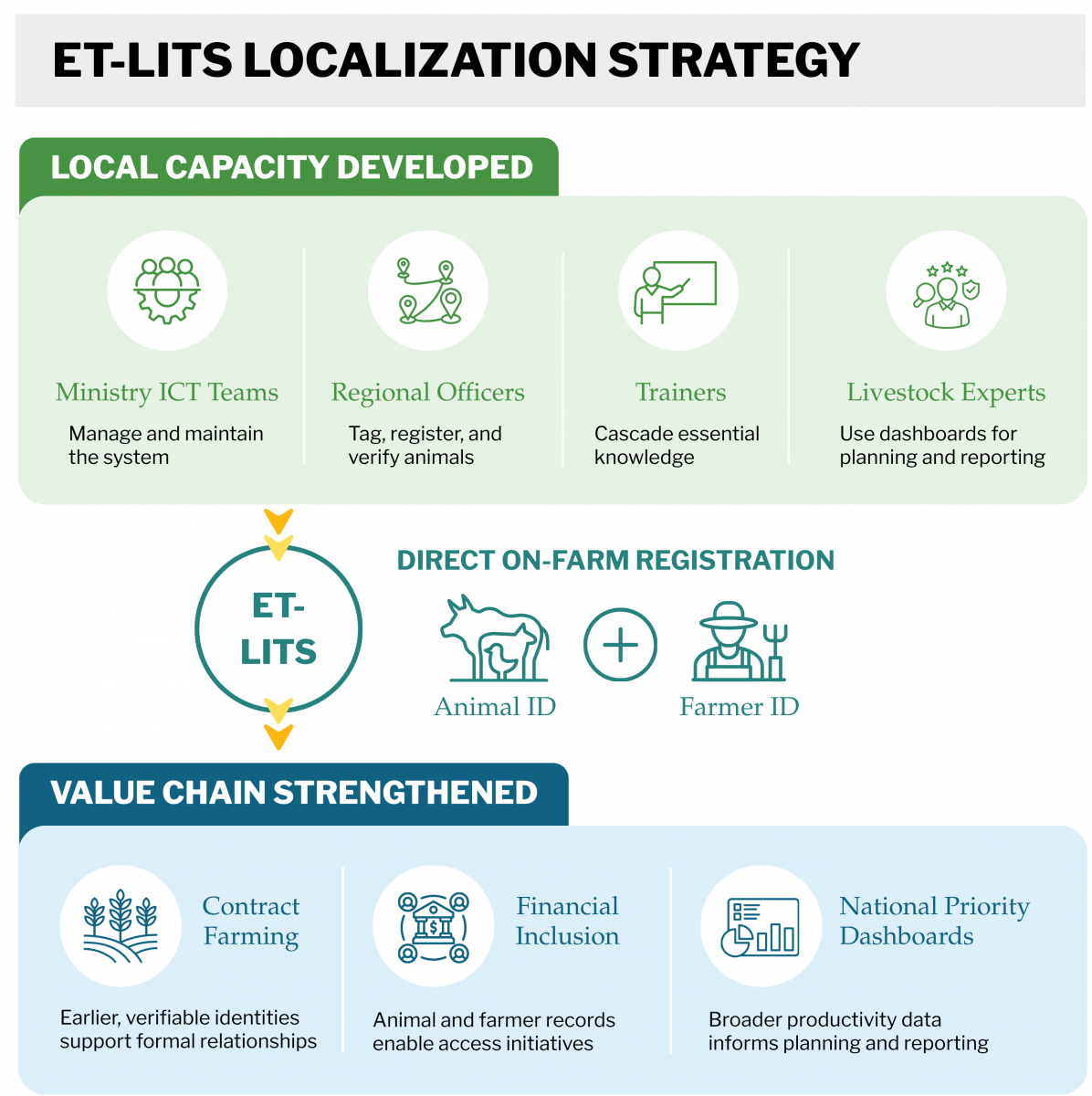
Capacity-building extended beyond the Ministry’s ICT team: regional officers, master trainers, and livestock experts were all equipped to run their part of the system. That distributed capability let ET-LITS evolve – animals are now registered directly on farms, giving animals and farmers verifiable identities earlier in the value chain to support contract farming and financial inclusion, while dashboards have broadened to track national priorities including milk, egg, and honey production.
Strengthen Policy Ownership and Leadership
The Ministry’s active involvement from the outset has been crucial. MoA livestock leaders – including State Minister, Dr. Fikru Regassa – hold seats on aLIVE’s governing committee; key system owners took part in the technical implementation committee and participated in co-design workshops. Decision-makers also participated in shaping livestock data standards, a governance framework, data access and sharing protocols, and a resource mobilization strategy. MoA system managers and livestock experts have been active decision-makers and co-creators, guiding the LIS direction and integrating data analysis into their daily work using tools like Power BI and Excel. Trainings were tailored according to MoA staff, who engaged actively to tell us what training they needed to impact their day-to-day work and data use. Knowledge shouldn’t collect dust on a shelf; staff learned how to operate tools that can be used daily, weekly, and monthly, institutionalizing knowledge instead. This shifts the system from an external add-on to an integral part of routine government operations. Consequently, the LIS leverages local ownership at multiple administrative levels to ensure the digital system is designed around Ethiopia’s priorities, policies, and realities, carefully reflecting high-level national commitments.
A significant milestone demonstrating this sustainable shift is the Ministry’s assignment of a dedicated data steward to coordinate across directorates, oversee system administration, and facilitate the ongoing institutionalization of the LIS into the Ministry’s broader digital governance architecture and resource mobilization efforts.
Co-creation is central to aLIVE’s work with the MoA on key policy ownership and data governance documents. A major accomplishment has been the development and implementation of National Livestock Data Standards for consistent, reliable, and actionable data. Following endorsement, a training-of-trainers approach was adopted, empowering MoA teams nationwide. With the Ministry now taking full ownership of cascading these standards and updating data collection formats, a robust national data foundation is being established. So far, over 300 experts and data collectors have been trained, with training continuing for nationwide adoption. The co-creation of national livestock data standards, governance frameworks, and data-sharing protocols ensures ET-LITS is tailored to Ethiopia’s specific context and needs.
Additionally, jointly developed frameworks, including governance structures, data access and sharing protocols, and the Resource Mobilization Strategy (RMS), establish roles, responsibilities, rules for data access, and a long-term financing plan. This ensures stability and sustainability from the outset. Resource mobilization efforts, including internal budget allocations and complementary support from partners like the International Livestock Research Institute, provide a strong model for the Ministry to continue sustaining and scaling the initiative.
ET-LITS was strategically repositioned by aLIVE and the MoA to be a comprehensive national livestock asset management system, beyond solely an export tracking mechanism. Repositioning the system involved localizing and enhancing ownership of LITS in order to expand its uses to fit country needs: Ethiopia needed expanded registration, integration, and financial inclusion. Fundamentally, a system better fit for purpose is a system more likely to be used, owned, and maintained by our partners.
This expansion involved:
- Expanding Registration: Broadening animal registration from just feedlots to include identification at the farm level, encompassing both pastoral and agro-pastoral production systems.
- Integrating Systems: Linking animal identification with national breeding programs and connecting traceability data with essential disease surveillance and vaccination records.
- Supporting Financial Inclusion: Recognizing livestock as digital assets to help facilitate financial inclusion for livestock owners.
This comprehensive transformation was realized through joint planning, technical working groups, and alignment with national priorities. As a result, ET-LITS is now fully integrated into Ministry structures, operationalized by trained government personnel, and guided by nationally owned policies.
Conclusion
Localization should be a practical commitment woven into both its daily operations and the long-term architecture of systems like the LIS and ET-LITS. This focus ensures that the investment in DPI is worthwhile for all parties and compelling to domestic owners. Prioritizing local ownership results in DPI that serves its intended purpose and is ready for connection/expansion to new systems, addressing new needs, making way for DPI at scale. Ultimately, investing in local ownership leads to sustainable DPI, achieved through key strategies:
- Building trust and relevance with stakeholders, particularly across government entities.
- Promoting system uptake and designing initiatives for increased buy-in [or use].
- Building domestic systems and data governance.
- Ensuring responsiveness to national development priorities and policies.
DPI shaped by national institutions and aligned with government priorities gains strength, trust, and wider adoption. When government stakeholders see their priorities reflected in DPI, it builds confidence and fosters long-term commitment. Sustainable DPI for agriculture demands a long-term commitment to people and institutions, not just technology. By collaborating closely with the MoA, providing continuous capacity building, and ensuring strong alignment with national priorities, Ethiopia’s Livestock Information System is a case study for how to approach boosting Ethiopia’s wider digital transformation ambitions in the livestock sector and beyond.
Ultimately, DPI for agriculture and other sectors must ensure that governments are well supported to independently manage, adapt, and expand digital systems over time, guided by the country’s own experts. This approach allows systems to evolve with changing needs, such as adapting for AI and other national priorities as they emerge. When true local ownership is established, capacity is robust, and policies are shaped locally, DPI can thrive long after a program concludes, continuing to inform decision-making and contribute to national development goals. In the end, it will allow Ethiopia – a country dependent on livestock – to harness the potential benefits we know that DPI can offer.