
Data on Youth and Tobacco in Africa Program Enters Phase II
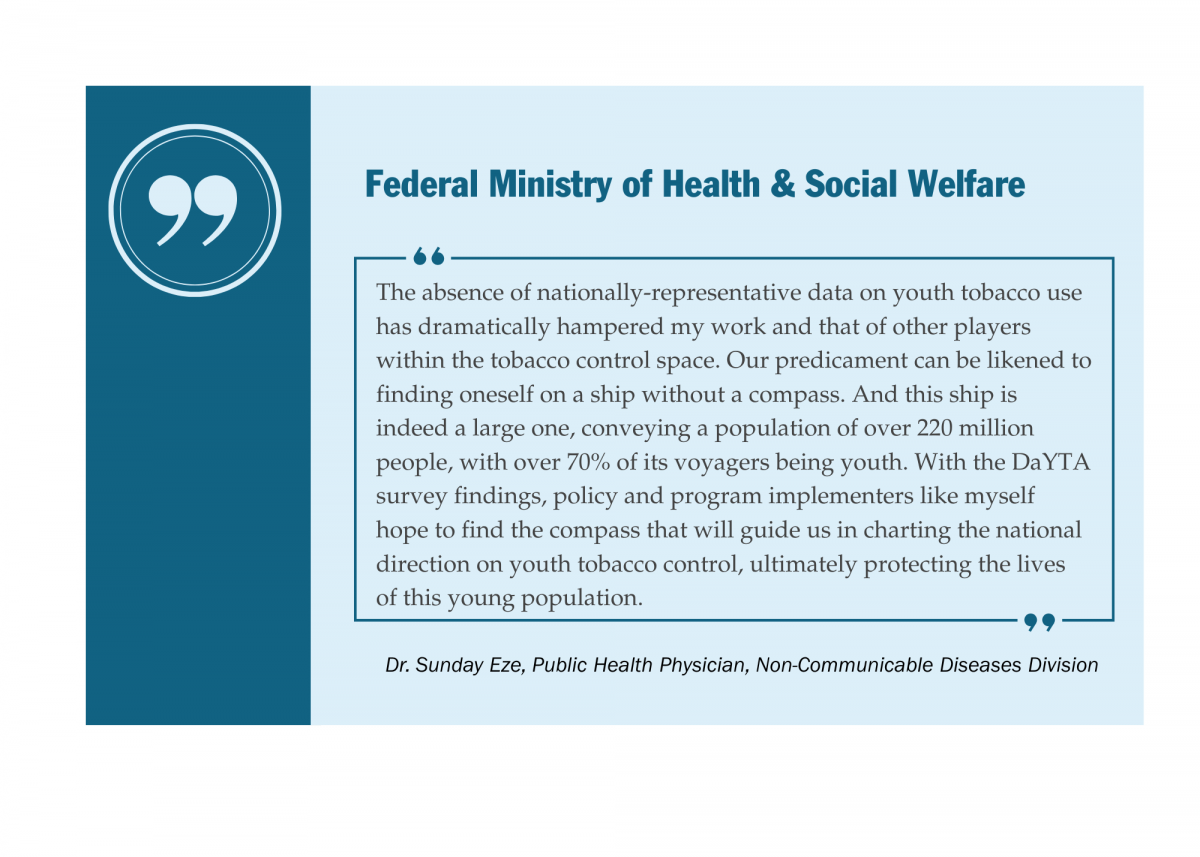
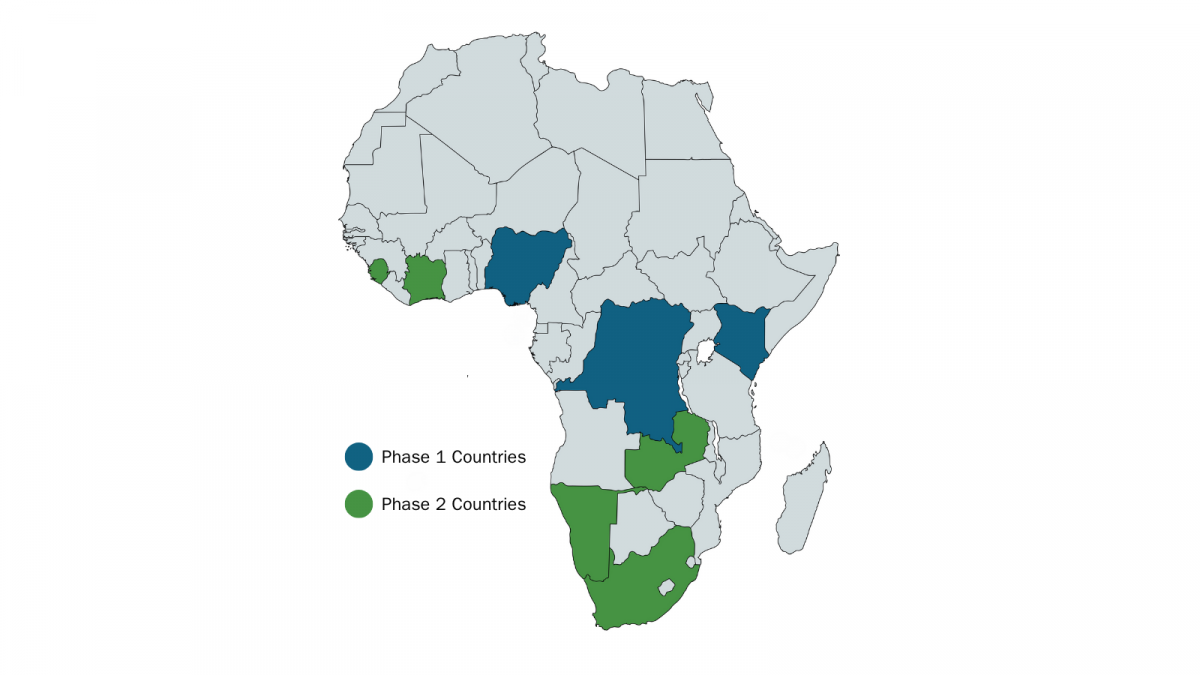
Launched in November 2022, DaYTA pioneered the first-ever nationally representative household surveys on tobacco and nicotine product use among adolescents aged 10–17 in the Democratic Republic of the Congo (DRC), Kenya, and Nigeria. These groundbreaking studies uncovered vital insights into adolescent tobacco use patterns, enabling policymakers, advocates, and researchers to better understand the risk this poses to Africa’s youth. The DaYTA program builds on the successes of the Tobacco Control Data Initiative (TCDI), where we partner with governments and civil society to collect, aggregate, analyze, and visualize existing and new tobacco control data. Utilizing country-specific platforms to present this data and to share the latest research and findings on tobacco control, TCDI websites have become trusted resources for policymakers, advocates, and researchers working to curb tobacco use.
Through TCDI, it became apparent there was a vast gap in data collected on youth tobacco use in Africa, which the DaYTA program has since been hard at work to fill. You can learn more about the data collection process of DaYTA’s first phase here, as well as check out the interactive TCDI portal here. In this blog, we’ll highlight DaYTA’s objectives, innovative approach, and the key activities we’re pursuing to drive impact in adolescent tobacco control measures across focus countries.
How DaYTA Transformed Adolescent Tobacco Data
Over the past three years, DaYTA has worked to ensure that data on adolescent tobacco and nicotine use in Africa is accurate and up-to-date. Prior to DaYTA’s inception, most available information on youth tobacco use in Africa came from school-based surveys conducted more than a decade ago. This resulted in major blind spots, including a lack of statistics on out-of-school adolescents, emerging nicotine products, and the rapidly shifting landscape of tobacco use across the continent. In our first phase, we broke new ground by conducting the first-ever nationally representative household survey on tobacco and nicotine use among adolescents aged 10-17 in the DRC, Kenya, and Nigeria. Across these three countries, we investigated key variables such as tobacco use prevalence and multi-level factors (e.g., individual- and household-level) associated with all forms of tobacco use, including smoked and smokeless tobacco products.
Our first phase of DaYTA delivered three major outputs: (i) country-specific research reports, (ii) a comparative analysis with its own report, and (iii) interactive Youth Prevalence pages hosted on the TCDI websites for DRC, Kenya, and Nigeria.
Added to this, three of our articles were published in peer-reviewed journals:
- Prevalence and determinants of tobacco use in 53 African countries: Evidence from the Global Youth Tobacco Survey (Addictive Behaviors Reports)
- Tobacco and nicotine product use among adolescents in Sub-Saharan Africa: protocol for a cross-sectional multi-country household survey (Frontiers in Public Health)
- What are the factors associated with alcohol, cigarette and marijuana use among adolescents in Africa? Evidence from the Global School-based Health Survey (British Medical Journal Open)
DaYTA’s approach distinguishes itself from other global adolescent tobacco surveys in three significant ways:
- Standardized yet locally rooted approach: Drawing on global best practices and existing surveys, we worked hand in hand with stakeholders from Ministries of Health, Education, and Youth, along with advocacy groups and adolescents themselves, to ensure the survey was both globally rigorous and locally relevant.
- Accurate mapping of the new and emerging tobacco landscape: Beyond traditional smoked tobacco products such as cigarettes, the survey included questions on the use of heated tobacco, e-cigarettes, and nicotine pouches – products that have never before been captured at a national scale in Africa. Given our exhaustive coverage of products, our data paints a fuller picture of youth tobacco use, filling notable gaps in existing datasets and answering governments’ most pressing questions.
- Broader reach of youth population: Unlike school-based surveys, our household-based approach reached both in- and out-of-school adolescents, who we have confirmed have the highest prevalence of tobacco use in all three countries surveyed. Our survey further included adolescents as young as 10 years old, expanding the age-range utilized by previous surveys.
DaYTA Phase 2
Following the strong reception of the DaYTA survey and growing demand from advocacy and policy groups, we are now launching the program’s second phase, expanding the approach to five additional countries: Côte d’Ivoire, Namibia, Sierra Leone, South Africa, and Zambia.
This second phase will focus on deepening engagement with key stakeholders – such as governments, research institutions, and youth advocates – to build trust and pinpoint remaining critical data gaps. Together, country teams will review the DaYTA methodology, confirm core questionnaire modules, and adapt optional modules to fit local contexts. Workshops will showcase how the survey addresses the identified data gaps, ensuring strong buy-in. In the first phase of DaYTA, the focus countries not only embraced the core content of the survey but also opted into all optional modules, underscoring enthusiasm for and broad support of the program. We hope to replicate this in future implementations as we expand to additional countries.
To ensure consistency across diverse settings, data collection will be conducted by local research firms, utilizing strengthened digital and quality assurance protocols, such as built-in digital checks coupled with independent review. This refined process will not only enhance data reliability but also enable meaningful cross-country comparisons and insights that connect and expand upon the findings from DaYTA’s initial phase.
When it comes to the dissemination of research, DaYTA’s findings won’t just sit in reports; they’ll be made accessible, visual, and actionable. We’ll share findings through the TCDI country websites, incorporating new youth-focused data and visualizations.
In the second phase of DaYTA, we will further build on the success of our pilot journalist training project, conducted in partnership with Nigerian NGO Renevlyn Development Initiative, and expand these activities to our additional focus countries. In the pilot, we provided training on tobacco control reporting to 20 DRC-based journalists, with the objective of equipping them with the skills to engage media outlets early, thereby speeding up the process of amplifying key findings. This will prove especially critical in countries with limited civil society presence, such as Namibia.
Harnessing AI
DaYTA’s second phase will also introduce a bold new AI workstream, aimed at exploring how artificial intelligence can be best used to transform our user experience, such as through engagement with new and existing dashboard content.
Through leveraging AI, we aim to make our tobacco control data more accessible, engaging, and actionable. Our objective is to co-design an AI-driven tool that draws on the expertise of tobacco control policymakers, researchers, advocates, and public health practitioners. By training the AI tool on this expertise and integrating it seamlessly into ongoing decision-making processes, we hope to create a solution that not only enhances usability and engagement but also addresses information overload as content grows. While we’re still in the preliminary design stages, our approach will mirror the rest of the program: high-quality, co-designed, and user-focused.
DaYTA’s Regional Leverage
As the influence from the tobacco industry increasingly crosses borders, regional alignment has become essential to closing policy gaps that weaken national tobacco control efforts. DaYTA’s geographic expansion and close integration with the TCDI make us uniquely positioned to drive impact beyond individual countries, thereby strengthening tobacco control across Africa’s Regional Economic Communities (RECs). With implementation spanning the Western, Southern, and Eastern African RECs and beyond, DaYTA and TCDI together form a robust regional evidence network. Their shared evidence base and comparable methodologies create a foundation for harmonized policy dialogue, enabling stakeholders to identify cross-border trends, align regulations, and address shared challenges such as illicit trade, youth access, and new and emerging tobacco and nicotine products.
For DaYTA Phase 1 countries (Kenya, DRC, and Nigeria), we envision our data and survey findings being actively used to improve national enforcement efforts that deter youth initiation and ultimately prevent tobacco-related illness and death. Although all countries prohibit the sale of tobacco to minors, adolescents continue to access these products with ease. While specific enforcement barriers vary by context – from retailer non-compliance and informal markets to gaps in community-level monitoring and limited cessation support for young people – these differences underscore the value of DaYTA’s comparable, cross-country evidence that sheds light on country-specific implementation gaps. Our stakeholders have also emphasized the need for cessation programs designed specifically for young people, reinforcing the demand for coordinated, evidence-based interventions.
By engaging government, civil society, and advocacy partners across multiple RECs, Development Gateway aims to translate DaYTA’s insights into regionally coherent strategies that strengthen health governance and protect young people from tobacco harms. In doing so, DaYTA moves from generating national data to shaping a coordinated regional response, transforming evidence into a catalyst for systems change across the continent.
Stay tuned for more about DaYTA’s second phase!