
Preparing Jordan’s Education System for the AI Age
Global education is at a crossroads: 250 million children and youth are out of school, and around 70 percent of 10-year-olds are unable to read and understand a simple text, a sharp increase since before the pandemic. Early grade education (EGE) is critical to reverse these trends, as it sets the foundation for children’s lifelong learning, cognitive development, and future opportunities, making it a cornerstone of national prosperity. The early years (birth through age 8) are marked by rapid brain development in young children, underscoring the urgency of investing in quality early learning. Research in various contexts, including studies referenced by UNESCO, suggests that EGE provides a 13% return through improved health and social cohesion.
Jordan has taken important steps in recent years to strengthen early grade education – which is referenced as a priority within its national economic modernization vision – including curriculum reform, teacher training, and the rollout of e-learning platforms. Education Reform for the Knowledge Economy programs (ERfKE I and II) and other ongoing education sector reforms have contributed to the country’s high primary school (grades 1-6) enrollment rate of 98-99%, positioning it in the upper-middle range of the MENA distribution for primary enrollment. Within this context, the Early Grade Education Activity, Asas (“foundation” in Arabic), is an IREX-led program, funded by the U.S. Embassy in Amman, and supported by Development Gateway: An IREX Venture (DG) and other consortium partners that is strengthening pre- and in-service teacher education while improving Kindergarten to Grade 3 foundational literacy, numeracy, and socio-emotional skills across Jordan.
Within ASAS, DG is supporting the development of a comprehensive data-informed environment that gives universities, teachers, schools, and the government the data and data governance policies needed to improve student learning across the entire country. For example,
- DG supports Jordanian university partners by developing data systems and dashboards that strengthen accreditation, institutional improvement, and support for student teachers.
- DG also works with IREX to integrate data on teachers’ professional development, career progression, classroom observation scores, and school performance into interoperable systems that can generate teacher and student “report cards.” These tools give decision-makers a clearer picture of where teaching is most and least effective and guide targeted and differentiated interventions.
- At the national level, DG supports IREX’s policy work by advising on data governance policies, with a focus on managing sensitive early grade data responsibly and securely.
Cutting across this data-informed environment is ongoing work to explore how ‘AI-ready’ the Jordanian early grades education system is, balancing AI’s powerful new ways to aggregate and analyze education data while addressing concerns about negative impacts on critical thinking, creativity, and equity.
What Meaningful AI Readiness Looks Like
There is a global race underway to develop AI tools. While education technology firms are developing AI-enabled features, students themselves are already bringing AI into the classroom. According to a 2025 report from HP, 61% of students are already using generative AI. The impact of AI on student learning and career preparation demands a shift toward a secure, responsible, and effective AI implementation that centers on core educational outcomes rather than a tools-first approach.
Cameron Mirza, Director for Asas at IREX, speaking at Times Higher Education’s Arab Universities Summit in Jordan, cautioned that universities’ “fear of missing out” on AI may be driving rushed decisions that overlook the financial sustainability of their AI models, leading to money being spent poorly. Universities must also confront whether they have the infrastructure needed to ensure equitable access. As Nader Sweidan, a digital transformation expert at Al-Ahliyya Amman University in Jordan, notes, “only about 45 percent of students [here] have consistent access to the kind of internet service that AI applications require.” Realizing the desired impact of AI for Education is about more than just selecting the right tools and skills, it is further shaped by the use of strong data systems, alignment with policies and objectives for digital sovereignty, and the recognition and reinforcement of trust building between teachers and students.
Impactful AI systems require strong data systems that are representative, reliable, and well-governed. DG’s Guide for Education Technology Systems underscores the importance of robust Education Management Information Systems (EMIS) and Learning Management Systems (LMS) as complementary pillars of a modern education ecosystem. EMIS platforms support ministries with planning, monitoring, and resource allocation, while LMS platforms enable design, delivery, and assessment of teaching and learning – including through AI-enabled features – and when integrated, they can connect student-level performance data with system-level policy decisions. This perspective has shaped our approach to the implementation of the AI Accelerator in Asas, where we are emphasizing high-quality, sustainable data pipelines as a prerequisite for responsible AI adoption rather than an afterthought.
Digital sovereignty is another critical construct for AI readiness efforts to consider. DG has a long track record of prioritizing open-source solutions as a technology preference wherever feasible. As we have recently written about in our Digital sovereignty and open source: the unlikely duo shaping DPI blog, open-source technologies can help countries assert sovereignty over their digital infrastructures by avoiding proprietary lock-in and increasing transparency over system architecture.
Finally, one lens too often neglected in the current rush to adopt AI tools for education is the need for preserving and strengthening trusted student-teacher connections. While digital and physical infrastructure are critical, relationship building is equally essential: strong, trusting student‑teacher relationships create the psychological safety students need to participate, take risks, and truly learn. In an AI‑enabled world, this human connection is the teacher’s irreplaceable value, turning content into real learning and schools into genuine communities.
Introducing the AI for Education Accelerator Program
Working in partnership with the Jordanian Ministry of Education (MoE), IREX, and DG are conducting a national AI readiness diagnostic assessment. The assessment will inform education policy and decision-makers on how prepared the Jordanian early grades system is to integrate AI safely, sustainably, equitably, and effectively.
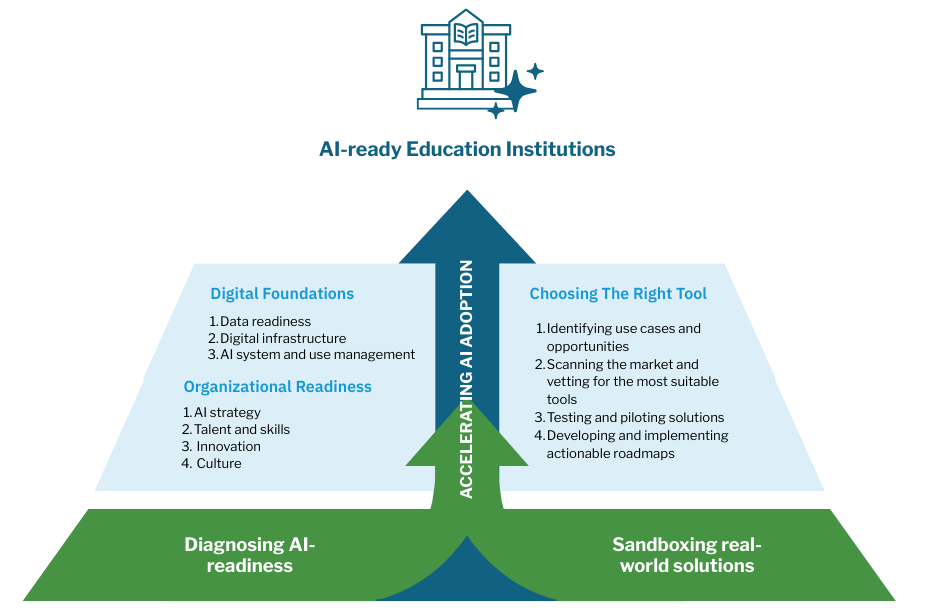
The assessment is based on IREX and DG’s new AI for Education Accelerator program. The Accelerator is built on two interlinked foundations:
- First, an AI readiness diagnostic assessment – implementable at both the ministry and university or school level – assesses organizational readiness (strategy, skills, innovation culture) and digital foundations (data readiness and governance, infrastructure, AI management and stewardship). This assessment integrates two complementary data collection tools: 1) a Teacher and Parent Survey of 5,000 early grades teachers and 400 parents of early grades students, and 2) in-depth Key Informant Interviews (KIIs) with ministry officials, field directorates, school leaders, and other stakeholders. Together, these tools provide both quantitative and qualitative insights on current AI use, perceived opportunities and risks, needed training and safeguards, and system-level readiness. They offer a comprehensive, system-wide view of AI readiness in Jordan’s education sector and provide an evidence base to develop an ambitious-but-achievable strategy for responsible, effective, and sustainable AI adoption.
- Second, a bespoke AI sandboxing process supports universities and schools to identify use cases, scan the global AI market, prototype shortlisted tools (or scope the development of new tools where gaps exist) that fit with the local context in safe staging environments using synthetic datasets, and develop actionable roadmaps to implementation.
The accelerator is being implemented in full partnership with the MoE. The process is being guided by a steering committee composed of representatives of a number of MoE departments, and MoE staff are actively involved in data collection, including through both engaging in interviews and supporting the piloting and roll-out of the survey. As the assessment progresses, MoE staff and education experts will be actively involved in the data analysis phase of the process, too.
This approach recognizes that sustainable implementation of AI in education systems is not about chasing the newest tool, but about ensuring leaders understand and trust AI’s potential while having the governance structures, skills, values, culture, and technical capacity to oversee and implement AI responsibly to generate cost-effective improvements to EGE delivery.
Accelerating Impact in Education in Jordan and Beyond
Looking ahead, we will continue working with Jordan’s Ministry of Education to complete the AI readiness diagnostic, with the intention that findings will guide strategic AI integration in early grade education for years to come. In parallel, we plan to implement the Accelerator program with our university partners, supporting them to identify and test AI use cases in teacher education, student support, institutional administration, faculty development, quality assurance and other priority areas.
Our work on AI in the Jordanian education system also feeds into our broader work on digital public infrastructure (DPI), where we are focusing on strengthening data exchange architectures and governance. Implementing AI readiness assessments and sandboxing in Jordan offers real-world evidence on how automation can be effectively, safely, and sustainably integrated into complex education data systems – evidence and experience that is directly relevant to inform our engagements in global DPI conversations.
Optimizing the impact — and insulating against the very real risks — of AI for education takes a rigorous, holistic, and adaptive approach to understanding educational institutions and the children and communities they serve. These tools and methods are being developed with adaptation in mind. and we are actively discussing collaboration with Universities in the region, and across West, East, and Southern Africa. By linking foundational early grade reforms, robust data systems, and a pragmatic, sovereignty-aware approach to AI, Jordan offers a practical blueprint for how education systems in lower- and middle-income countries can prepare for AI in ways that are safe, ethical, and aligned with national priorities.