
Strengthening Online Safety Through Prevention in the Philippines
Technology-facilitated gender-based violence (TFGBV) continues to evolve alongside emerging technologies, making it harder to understand its full scale and impact. According to UNFPA and UN Women, the prevalence of TFGBV in the Asia-Pacific region is extremely high, with some studies indicating that up to 88% of women in the region have experienced online violence.
In response, Development Gateway has been working on a program to address TFGBV in the Philippines, known as the National Models for Women’s Safety Online (NMWSO). The initiative seeks to address threats to women’s engagement and leadership in digital spaces. Alongside our partner IREX, the team has been working with public and private sector actors in Kenya and the Philippines to document, test, and advance system-level responses to prevent and mitigate online abuse targeting women leaders.
In this blog, we will share our findings from our work in the Philippines.
The Philippines’ online safety model: Progressive laws, limited recourse
In 2025, we conducted a Landscape Assessment in the Philippines to understand the online safety models, examining laws, reporting mechanisms, and platform regulation and accountability. According to the Assessment, data on TFGBV remains inconsistent, fragmented, and rarely disaggregated – limiting policymakers, platforms, and support organizations’ ability to respond effectively.
Our findings revealed that the Philippines has progressive laws that protect women and children in online spaces from individual perpetrators, such as the Safe Spaces Act (RA 11313) and the Anti-Online Sexual Abuse or Exploitation of Children (OSAEC). However, platform regulation is comparatively weaker, reflecting a different regulatory approach from the EU, UK, and Australian models, which place stronger obligations on platforms to ensure their products are safe for users. Furthermore, reporting and recourse mechanisms can be challenging for survivors to navigate.
Respondents to our study reported challenges in seeking accountability and justice in response to TFGBV. Survivors rely on platforms where the abuse was perpetrated for help, and while explicit images are often taken down quickly, responses to non-image-based abuse – especially in local languages – face prolonged delays. In addition, those who do pursue criminal or civil cases face complex legal procedures, a slow-moving justice system, and limited knowledge of TFGBV within some judicial and law enforcement agencies.
We worked with the public and private sectors to develop recommendations based on our findings to improve online safety in the Philippines. Among them were recommendations to upskill law enforcement agencies and improve services and outcomes for survivors. Additionally, we recommended that Safety By Design (SbD) be considered to address risks before launching digital products. Both the private and public sectors welcomed this approach as a proactive way of creating a safer internet without the risk of over-regulation or undermining free speech and innovation.
Safety by Design is a concept that originated with industrial safety efforts in the early 19th century, developing into formal, systematic methodologies by the 1990s. The methodology encompasses systematically considering risks before releasing a product, an approach championed by the eSafety Commissioner in Australia. Led by IREX, NMWSO designed a Safety by Design curriculum and facilitator guide with the aim of equipping mid-level technology-based product professionals with knowledge and skills to effectively and sustainably implement and integrate SbD principles throughout their product life cycles. The guide can be accessed here.
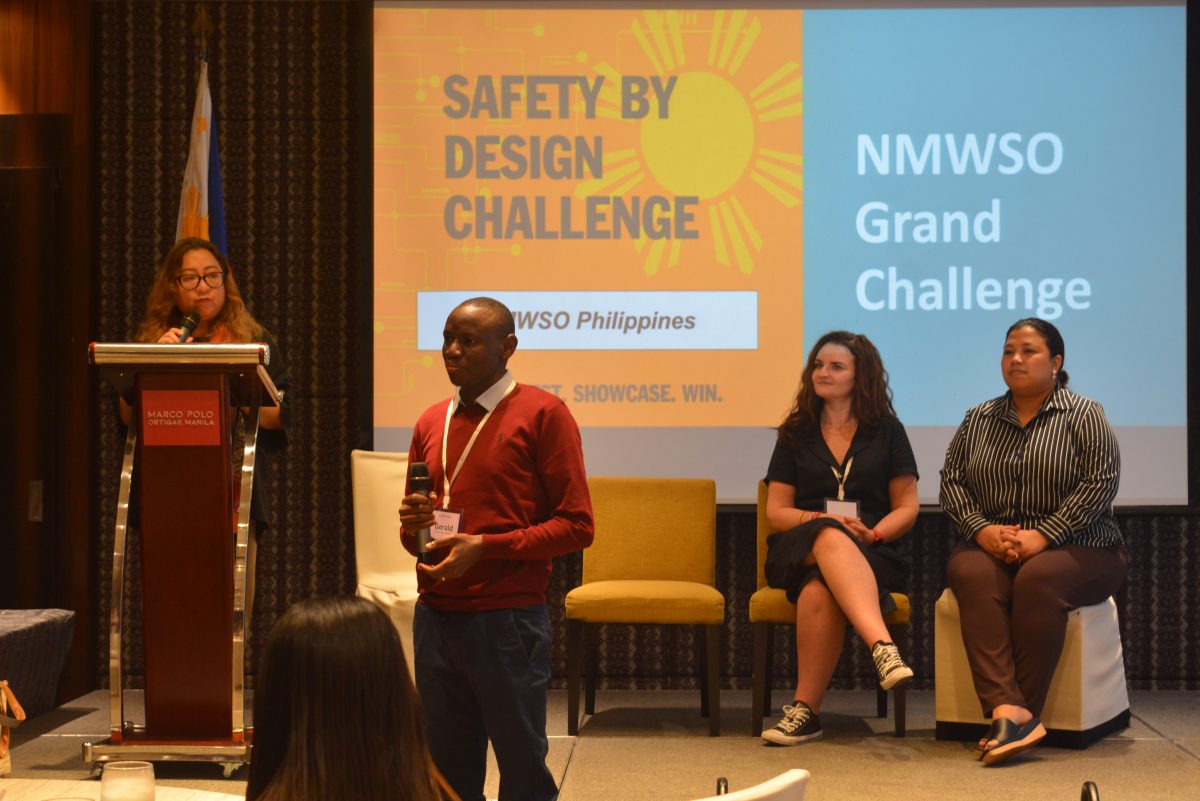
Incentivising proactive safety measures through the Safety-by-Design Grand Challenge
To translate prevention principles into practice, the NMWSO program convened a Safety-by-Design Grand Challenge with the private sector in the Philippines. The Grand Challenge encouraged platforms and start-ups to embed safety considerations directly into their designs, and to identify and address potential risks before harm occurs, including exploring design features that reduce opportunities for abuse, strengthen user reporting and moderation, and improve transparency and accountability mechanisms.
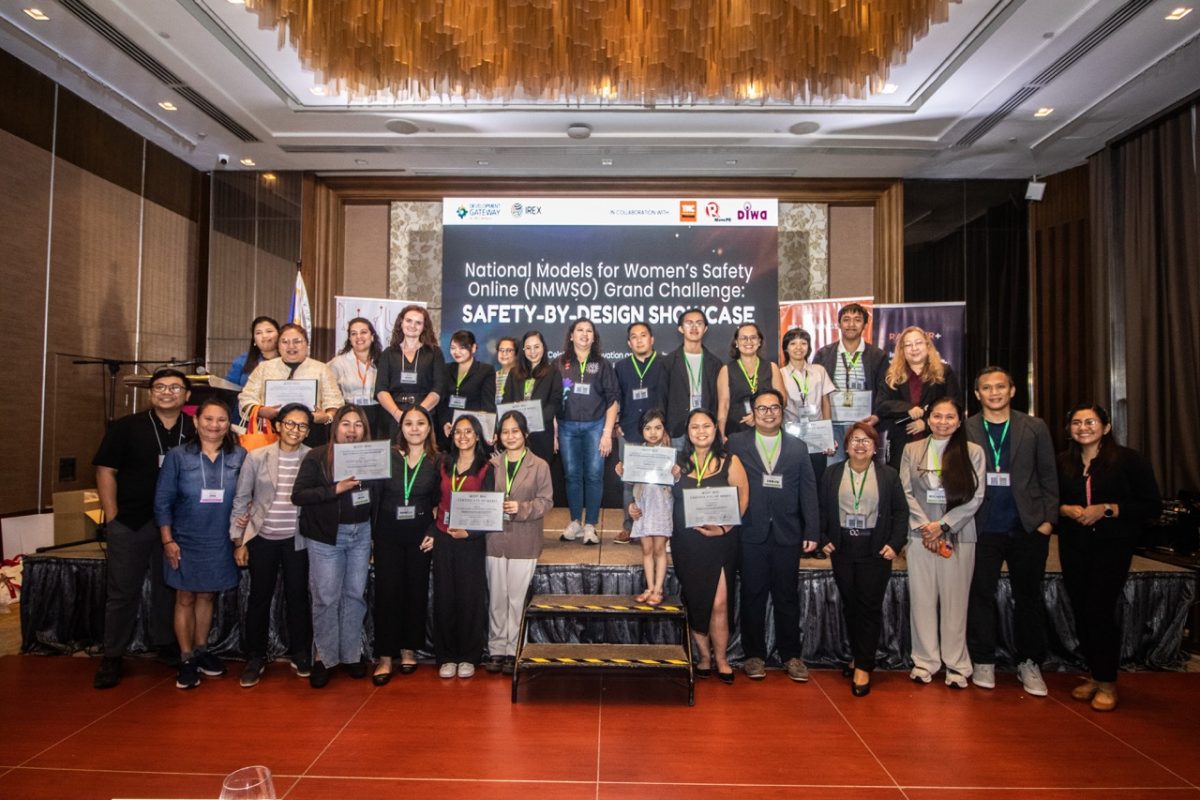
Through the Grand Challenge, the participating platform developers demonstrated a wide range of solutions, from community safety and emergency reporting tools to women-led livelihood marketplaces, embedding privacy, safety, and user empowerment at their core. It also served as a crucial venue for interaction among major industry players that highlighted their ongoing efforts aligned with the SbD principles. Grab, a ride-hailing app, publicly committed to embedding SbD in driver training and creating safer, women-centered communities both online and offline. Similarly, Globe, a telecommunications company, emphasized that trust and safety must be treated as a shared, non-negotiable responsibility and a whole-of-nation mission.
The discussions included the public sector entities, such as the Philippine Police Anti-Cyber Crime Prevention Group, the Department of Information and Communications Technology (DICT), and the Philippine Commission on Women (PCW), and private sector stakeholders that support prevention as a driver of innovation, trust, and long-term user engagement rather than a regulatory burden.
The success of the Grand Challenge highlights the potential for public-private partnerships to advance proactive safety standards. For the Philippines, this collaborative model presents a scalable strategy to strengthen existing legal frameworks with forward-looking, design-based protections.
Beyond this, the education sector also plays a big role in mainstreaming the SbD lens within the tech industry and shaping the country’s major future digital ecosystem. The NMWSO program collaborated with several leading universities offering courses on software development, technology innovation, or AI governance to embed SbD into their curricula. By embedding SbD principles into education, these institutions are helping build a pipeline of future developers, innovators, and leaders who view safety, privacy, and human-centered design as foundations for technology development.
As Senator Risa Hontiveros, Chairperson of the Senate Committee on Women, Children, Family Relations, and Gender Equality, emphasized at NMWSO’s 16-Day Campaign against GBV event, laws and policies must keep pace with rapidly evolving technologies. She noted that this is only possible if civil society, the private sector, and individuals collectively demand more secure technologies, highlighting the importance of the SbD approach in ensuring that prevention is embedded throughout the technology development process.
By integrating the Philippines’ robust legal protections with preventive frameworks, the Philippines can create safer, more equitable digital spaces. Moreover, implementing SbD principles is feasible, even within the resource constraints faced by both government and private-sector entities.